[REC · RE100 Series · Episode 1] What Is a REC?The Second Revenue Stream of Renewable Energy
What Is a REC?
The Second Revenue Stream of Renewable Energy
A complete breakdown of Korea's Renewable Energy Certificate system by a power market professional
Selling Electricity AND a Certificate — The Hidden Profit in Renewable Energy
Sunlight hits the panels, electricity is generated, and you sell it to KEPCO.
But in fact, there is a second thing you can sell.
That second thing is a certificate proving "this electricity was generated from renewable energy" — a REC (Renewable Energy Certificate), or in Korean, a 신재생에너지공급인증서.
Electricity is invisible. There is no way to tell whether the power from your outlet came from solar, coal, or nuclear. That's exactly why RECs were created: an official document certifying that electricity was produced from renewable sources.
What Exactly Is a REC?
| Category | Details |
|---|---|
| Korean Name | 신재생에너지공급인증서 |
| English Name | Renewable Energy Certificate (REC) |
| Issuance Basis | 1 REC per 1 MWh of renewable energy produced |
| Validity Period | 3 years from date of issuance |
| Issuing Authority | Korea Energy Agency (KEA) |
| Trading Methods | Spot market / Contract market / Voluntary RE100 purchases |
Why Were RECs Created? — The Need Born from Carbon Neutrality
RECs were born from Korea's mandatory renewable energy deployment policy. In 2012, Korea introduced the RPS (Renewable Portfolio Standard), requiring large generators to source a set percentage of their total output from renewables.
How Are RECs Created? — From Generation to Trading
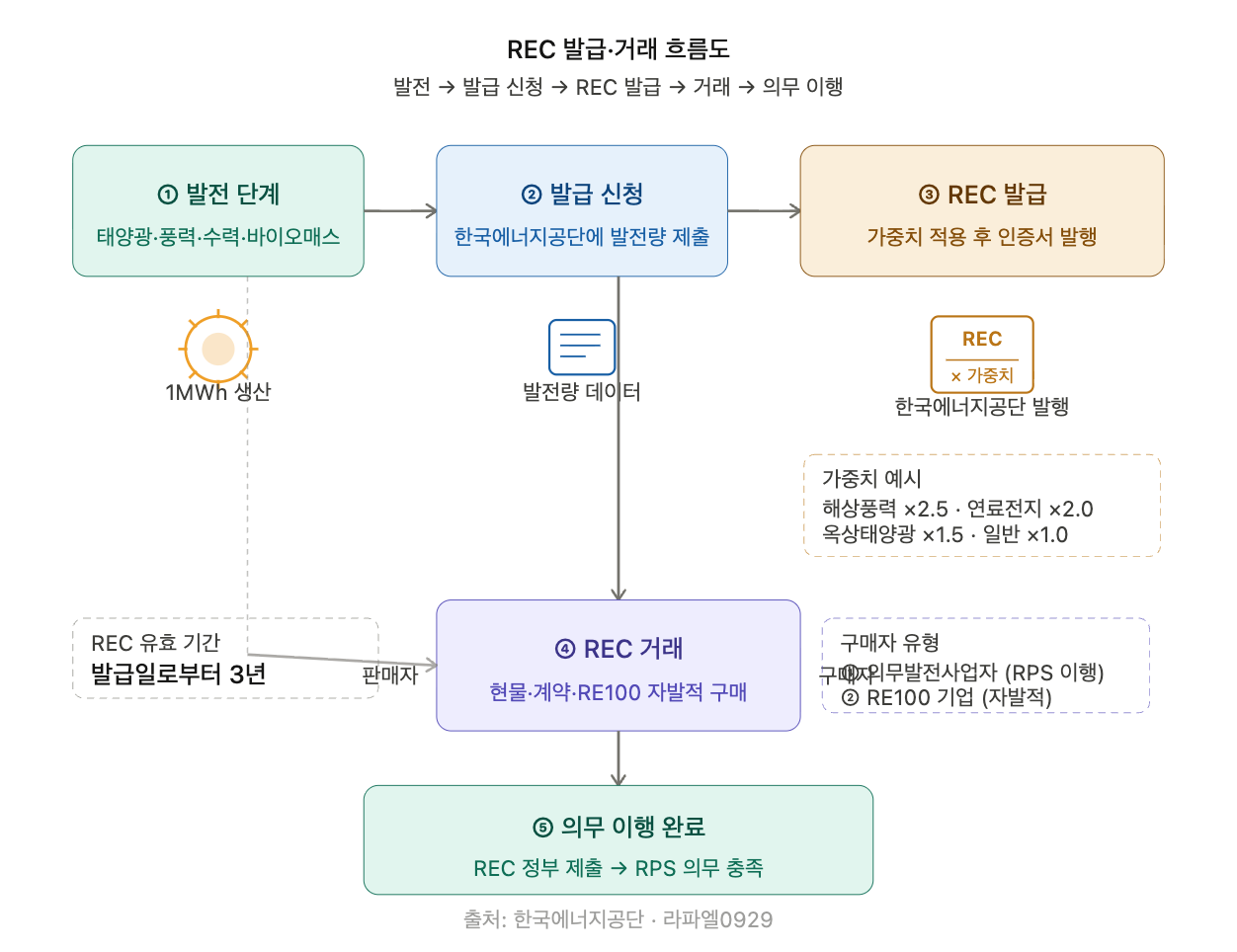
REC flow diagram: Generation → Application → Issuance → Trading → Compliance fulfillment
Power Generation
Solar, wind, hydro, biomass and other renewable facilities generate electricity.
Application
The operator submits verified generation data to the Korea Energy Agency and applies for REC issuance.
REC Issuance
The KEA verifies output records and issues RECs — with weighting factors applied based on the energy source type.
REC Trading
Issued RECs are sold in the spot or contract market to obligated generators or voluntary RE100 corporates.
Compliance Complete
Obligated generators (KEPCO subsidiaries, large private generators) submit purchased RECs to authorities — obligation fulfilled.
REC Weighting Factors — Not All 1 MWh Is Equal
One of the most interesting features of Korea's REC system is that weighting factors differ by generation type. The same 1 MWh of output earns a different number of RECs depending on how it was produced.
| Generation Source | Weight | Level | Rationale |
|---|---|---|---|
| Solar (ground-mount) | 1.0 | Base | Baseline weighting |
| Solar (building rooftop) | 1.5 | Premium | Incentive for utilizing idle rooftop space |
| Small-scale solar (<100kW) | 1.2 | Premium | Encourage distributed small-scale deployment |
| Onshore wind | 1.0 | Base | Baseline weighting |
| Offshore wind | 2.0–2.5 | High | Reflects higher installation cost & difficulty |
| Fuel cells | 2.0 | High | High-efficiency technology premium |
| Biomass | 0.5–1.0 | Variable | Varies by co-firing ratio with fossil fuels |
How Is the REC Price Determined?
REC prices are determined by market supply and demand, much like any commodity.
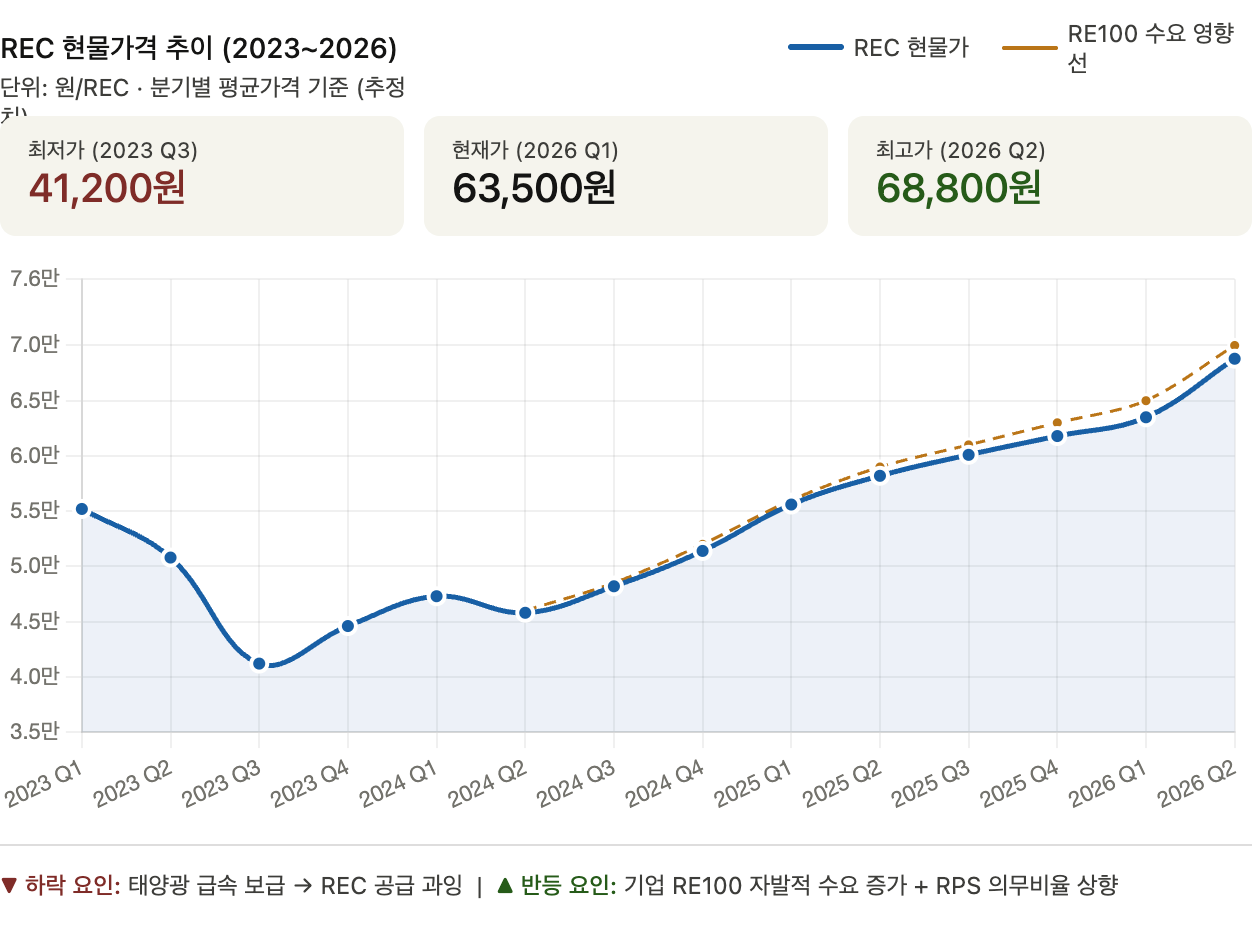
In the early 2020s, REC spot prices fell as low as ₩50,000 before stabilizing with supply-demand shifts. Rapid solar buildout creates supply surplus risk, but growing corporate RE100 demand has emerged as a new structural price support factor.
RE100 and RECs — Why Corporations Are Buying
Korean conglomerates — Samsung Electronics, SK Hynix, LG Energy Solution, and others — have been making RE100 pledges in rapid succession.
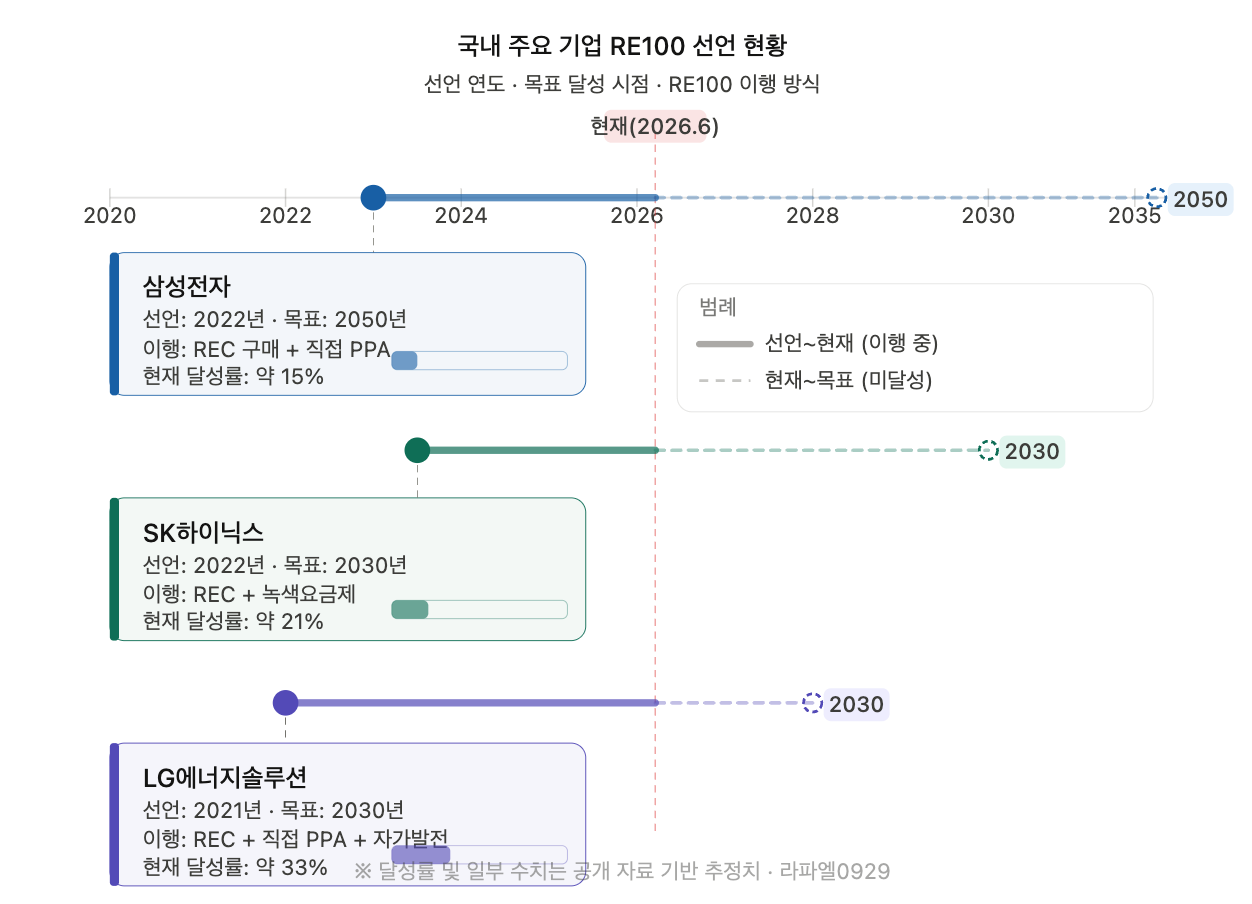
Major Korean corporations' RE100 pledge timeline and current progress
REC vs. SMP — The Two Revenue Streams of Renewable Generators
| Revenue Source | Concept | Pricing Mechanism |
|---|---|---|
| ⚡ SMP (System Marginal Price) |
Revenue from selling electricity in the power market | Set by power market supply/demand dynamics |
| 📜 REC (Renewable Energy Certificate) |
Revenue from selling renewable energy certificates | Set in the separate REC market |
Reader FAQs
| Item | Content |
|---|---|
| What is a REC? | Official certificate issued per 1 MWh of renewable energy generated |
| Origin | Korea's RPS system introduced in 2012 |
| Weighting | 0.5× to 2.5× depending on generation source |
| Trading | Spot market / Contract market / Voluntary RE100 purchases |
| Validity | 3 years from issuance |
| Market Scale | Multi-trillion KRW annual certificate market |
Investment Takeaways
- ✅Renewable energy project revenue = SMP + REC — analyzing only electricity sales gives an incomplete picture
- ✅Higher-weighted sources (offshore wind, small-scale rooftop solar) offer stronger unit economics per MWh
- ✅Growing RE100 corporate commitments → voluntary REC market expansion → emerging investment opportunities
- ✅Supply surplus risk is partially mitigated by rising RPS obligation ratios under government policy
Conclusion
"RECs are the second revenue stream of renewable power plants —
and a critical infrastructure of the carbon-neutral era."
Points to Watch
- ①RPS obligation ratio trajectory — government policy is the primary driver of REC demand
- ②Corporate RE100 adoption pace — monitor the growth rate of voluntary demand
- ③Offshore wind development progress — track whether high-weight REC supply is materializing
Having watched Korea's REC market evolve for years, I've seen it transform from a pure compliance instrument into a core pillar of corporate ESG strategy.
In an era where renewable energy usage ratios are becoming supply chain prerequisites — where a major semiconductor buyer can mandate green power sourcing from its vendors — RECs are no longer a concern exclusive to power generators.
The center of gravity in the REC market is shifting from mandatory compliance toward voluntary corporate demand. Those who read this transition early and position accordingly will capture first-mover advantage in one of Korea's most structurally important energy markets.