[REC·RE100 Series] Episode 4, Solar Power Operator Revenue Structure
Solar Power Operator
Revenue Structure
SMP electricity sales + REC certificate sales — weights, fixed contracts, and a real 100kW calculation
How Does a Solar Power Plant Actually Make Money?
Now let's go one level deeper.
Where, exactly, does a solar plant operator earn revenue?
The answer has two parts — from selling electricity (SMP), and from selling certificates (REC).
Today we'll fully break down the two revenue streams for Korean solar operators — SMP and REC — how the REC weighting system affects earnings, how the three sales channels (spot market / fixed contract / PPA) compare, and a real worked calculation for a 100kW plant.
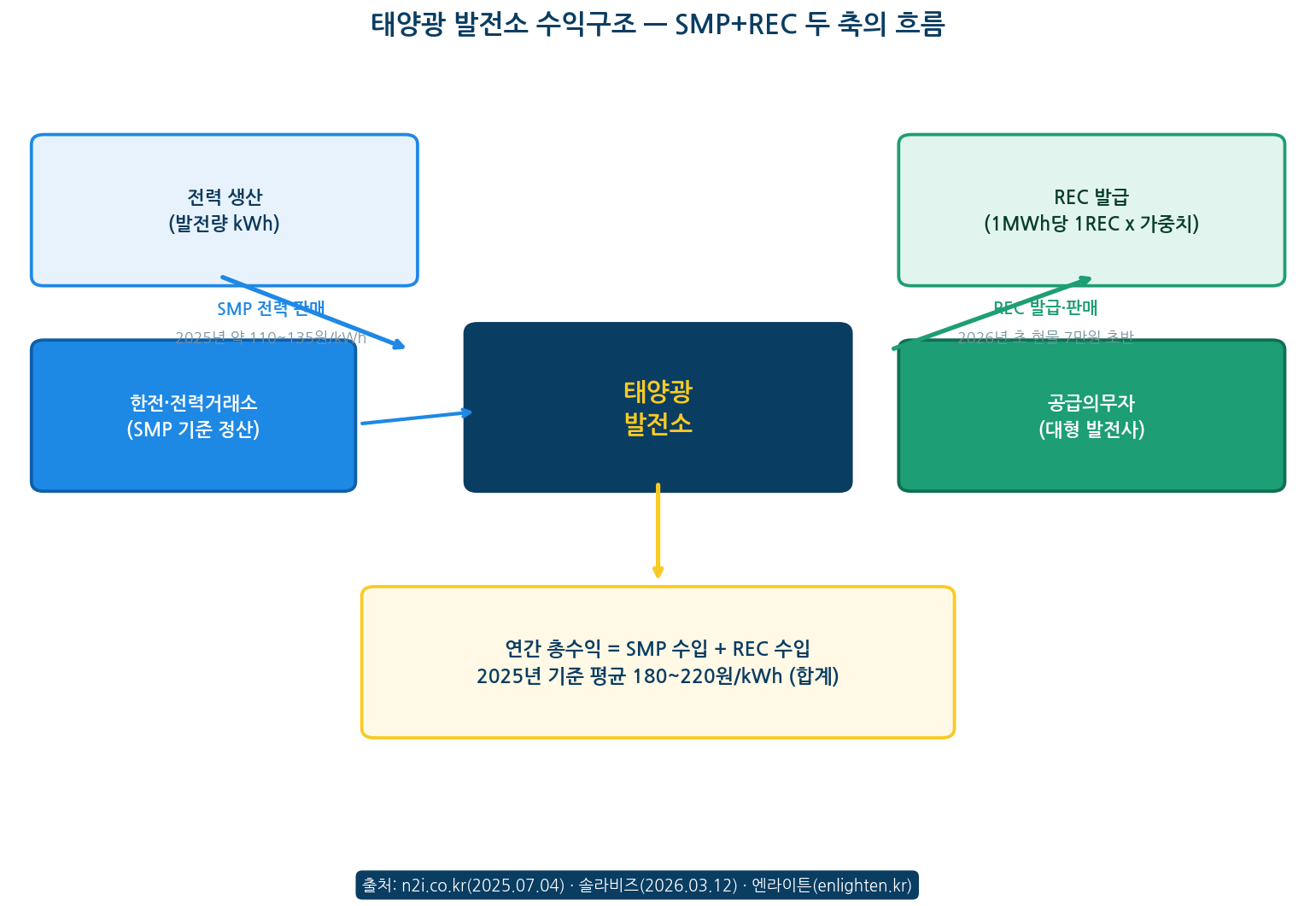
Two Revenue Streams — SMP and REC
※ Source: Enlighten.kr (revenue calculation formula) / SolarConnect Medium (May 10, 2019) — REC revenue calculation method
Sell Power at the System Marginal Price
Electricity generated is sold to KEPCO or the Power Exchange at the hourly SMP. 2025 reference: approximately ₩110–135/kWh. Varies by time, season, and year.
Sell Renewable Energy Certificates (RECs)
1 REC issued per 1 MWh generated (×weight) → sold to Renewable Portfolio Standard obligated parties (large generators). Early 2026 spot price ~₩70,000–80,000/REC.
※ Source: n2i.co.kr (Jul 4, 2025) — 2025 SMP ₩110–135/kWh, REC adds ₩70–90/kWh, average ₩180–220/kWh total / Solarbiz.kr (Mar 12, 2026) — early 2026 mainland SMP in mid-₩110s, REC holding ₩70,000+ floor
REC Weights — Same kWh, Different Revenue
While the base rate is 1 REC per 1 MWh, weights vary by installation type and scale, changing how many RECs are actually issued. A higher weight means more RECs — and more revenue — from the same generation volume.
| Installation Type | Scale | REC Weight | Notes |
|---|---|---|---|
| General site (ground) | <100kW (small) | 1.2 | General land, non-forest |
| General site (ground) | 100kW–3MW (mid) | 1.0 | Mid-scale ground installation |
| General site (ground) | >3MW (large) | 0.8 | Economies of scale reflected |
| Building (roof/rooftop) | <3MW | 1.5 | Premium — urban utilization encouraged |
| Building (roof/rooftop) | ≥3MW | 1.0 | Large building treated as baseline |
| Floating (water surface) | <100kW (small) | 1.6 | Highest weight |
| Floating (water surface) | 100kW–3MW (mid) | 1.4 | Mid-scale |
| Floating (water surface) | >3MW (large) | 1.2 | Large-scale |
| Mountain/forest site | All | 0.5 | Slashed to deter environmental damage |
※ Source: e2news.com (Jul 29, 2021) — building <3MW 1.5 retained, ≥3MW 1.0, general site small 1.2 / mid 1.0 / large 0.8 (up from 0.7); E-Times (Jul 28, 2021) — floating small 1.5→1.6, mid 1.5→1.4, large 1.5→1.2, mountain 0.7→0.5

Three Ways to Sell RECs — Spot, Fixed Contract, PPA
| Channel | Revenue Stability | Expected Return | Best For |
|---|---|---|---|
| Spot market | Low (price swings) | High when prices rise, low otherwise | Short-term, price-upturn opportunism |
| Fixed-price contract | High (20-year term) | Moderate (competitive auction) | Small–mid scale, stability preference |
| Direct PPA | Very high | Depends on negotiation | Mid–large with RE100 corporate buyers |
※ Source: SolarConnect Medium (May 10, 2019) — spot market opens Tue/Thu 10–16h, ±30% daily limit, 3-year expiry / Solarbiz.kr (Mar 12, 2026) — direct PPA aggregated model established H2 2025, 20-year stability
Projects ≥100MW: completion deadline extended to 36 months / PPA brokerage market introduced in parallel
Let's Calculate — 100kW General-Site Solar Plant
Let's work through the annual revenue for the most common small-scale setup: a 100kW general-site solar plant. Assumptions: 3.7 hours of daily generation, weight 1.2 (below 100kW), SMP ~₩120/kWh, REC spot ~₩70/kWh.
※ Source: Enlighten.kr — daily generation 3.7h assumption, ~10% operating cost ratio / n2i.co.kr (Jul 4, 2025) — 2025 SMP ₩110–135/kWh, REC ₩70–90 added / initial investment ~₩130M for 100kW (Enlighten.kr), equity ROI potential 13–18%

REC Price Risk — Why the Spot Market Is Dangerous
As Episode 2 covered, REC spot prices crashed from ₩104,688/REC in 2017 to the ₩20,000s in 2021. Operators relying solely on the spot market absorbed this collapse directly. Prices recovered to around ₩76,500 (Oct 2024 reference) and are holding the ₩70,000-plus floor in early 2026 — but volatility remains significant.
Reader FAQs
| Item | Content |
|---|---|
| Two revenue streams | ① SMP (electricity, ₩110–135/kWh) + ② REC (certificates, ₩70–90/kWh additional) |
| Highest weights | Floating (small-scale) 1.6 / Building <3MW 1.5 |
| Lowest weight | Mountain/forest solar 0.5 (environmental deterrence policy) |
| 3 sales channels | Spot market (volatile) / Fixed-price contract (20-yr stability) / Direct PPA (RE100 corporates) |
| 100kW revenue estimate | Annual net ~₩20–25M (varies with site conditions and prices) |
| 2025 auction change | Modules exceeding 710kg CO₂/kW or unverified: zero evaluation points |
Investment Takeaways
- ✅ Building-integrated solar (rooftop) — weight 1.5 vs. general site 1.0–1.2 gives REC revenue edge; watch idle urban rooftop lease business opportunities
- ✅ RE100 direct PPA demand growth → aggregated PPA for 3+ small plants now established (H2 2025), opening new exit strategy for small-scale operators
- ✅ Fixed-contract carbon standard tightening (2025) — rising demand and premium for low-carbon domestic modules; domestic panel manufacturers may benefit
- ✅ Early 2026 REC spot ₩70,000+ floor + SMP mid-₩110s — current market at ~₩180/kWh total, meaningful recovery from the crash-era lows
Conclusion
"Solar revenue is determined by the product of two choices:
where you build (weight) and how you sell (channel)."
Points to Watch
- ①2025–2026 fixed-price contract winning-bid trend — the auction ceiling price and competition ratio signal market profitability
- ②Aggregated PPA market growth speed — matching platforms connecting RE100 corporate demand with small-plant supply are the key new players to watch
- ③Carbon verification requirements tightening further — as fixed-contract entry standards rise, securing low-carbon module supply becomes the critical success factor
Understanding solar operator revenue reveals the design philosophy behind Korea's renewable energy policy. The government uses REC weights to signal "where to build," and fixed-contract carbon standards to signal "which panels to use." Floating (1.6) and buildings (1.5) high; mountains (0.5) low — this isn't just revenue adjustment, it's land-use direction through price signals.
Simultaneously, the rise of RE100 direct PPA is an intriguing development: a new market emerging outside the government-designed RPS/REC system, where generators and corporates trade directly. How these two markets compete and complement each other will be the defining story of Korea's renewables market going forward. Episode 5 will examine why RE100 companies prefer direct PPA — and what the real costs and benefits look like.
- n2i.co.kr, "2025 Solar Installation Revenue Summary Table — One-Stop Comparison with Real Data" (Jul 4, 2025) — 2025 SMP ₩110–135/kWh, REC adds ₩70–90, average ₩180–220/kWh total, 100kW annual ₩19–33.8M / monthly net ₩1.5–2.3M, 3–10kW payback period 5–7 years
- Solarbiz.kr, "Can I Aggregate 3×100kW Plants for a RE100 PPA Deal? Profitability Analysis" (Mar 12, 2026) — early 2026 mainland SMP mid-₩110s, REC holding ₩70,000+ floor, aggregated PPA established H2 2025, PPA stability vs. spot opportunity cost comparison
- Enlighten.kr, "Converting Empty Space to Income — 'Solar Project Site Feasibility A to Z!'" — annual revenue formula: capacity × daily hours × 365 × (SMP+REC×weight), 3.7h/day generation assumption, ~10% operating cost ratio, ~₩130M initial investment for 100kW
- SolarConnect Medium, "How Does a Solar Plant Make Money? — REC Revenue Calculation" (May 10, 2019) — spot market Tue/Thu 10–16h, ±30% daily limit, 3-year REC expiry, fixed-price SMP+REC×weight formula, ₩50/REC issuance fee for ≥100kW
- E-News (e2news.com), "Building Solar REC Weight Maintained at Current Level" (Jul 29, 2021) — building <3MW 1.5 retained (reversal of proposed reduction), ≥3MW 1.0, general site small 1.2 / mid 1.0 / large 0.8 (from 0.7)
- E-Times (etnews.com), "Ministry Confirms REC Weight Revision — Building Solar Weight Unchanged" (Jul 28, 2021) — floating small 1.5→1.6, mid 1.5→1.4, large 1.5→1.2, mountain 0.7→0.5 (to suppress new entrants)
- Ministry of Trade, Industry and Energy / New & Renewable Energy Act Enforcement Decree, Annex 2 "Weight by New & Renewable Energy Source" — REC issuance basis (1 MWh = 1 REC × weight), building eligibility criteria (construction, use, timing), classification definitions
- Haezoom Blog, "2025 H1 Solar Fixed-Price Contract Competitive Bid Analysis" (Jun 12, 2025) — carbon emissions 710kg CO₂/kW exceeded or unverified = zero points (2025 tightening), ≥100MW projects 36-month completion window, PPA brokerage market intro, submission period May 26–Jun 25, 2025
- Korea New & Renewable Energy Center (KNREC), "RPS FAQ — Solar Facility Confirmation" (as of Aug 22, 2024) — building premium weight criteria (construction / use / timing), parking facility eligibility, separate metering requirement for mixed-installation sites
- Enlighten.kr Support, "What Are RPS, REC, and SMP?" — RPS obligated parties (≥500MW generators), obligation ratio 12.5% (2022) → 25% target (2026), REC purchase as compliance method
※ Latest SMP and REC prices are available at KPX EPSIS (epsis.kpx.or.kr) and the Korea Energy Agency RPS market price page.